Research · Semiotics of the city
Situación de calle
Unsheltered people — people in street situations
How does a person who needs somewhere to sleep read — and resist — a city designed to keep them away?
Starting from Umberto Eco’s lector in fabula, Rocco Mangieri proposes the lector in urbis: the urban actor who reads the city as a text, looks for the fables and ideologies that hold its plot together, and can rewrite it through acts of appropriation. Among the many possible readers of the city — residents, tourists, strangers — he stops at one: the person who lives on the street.
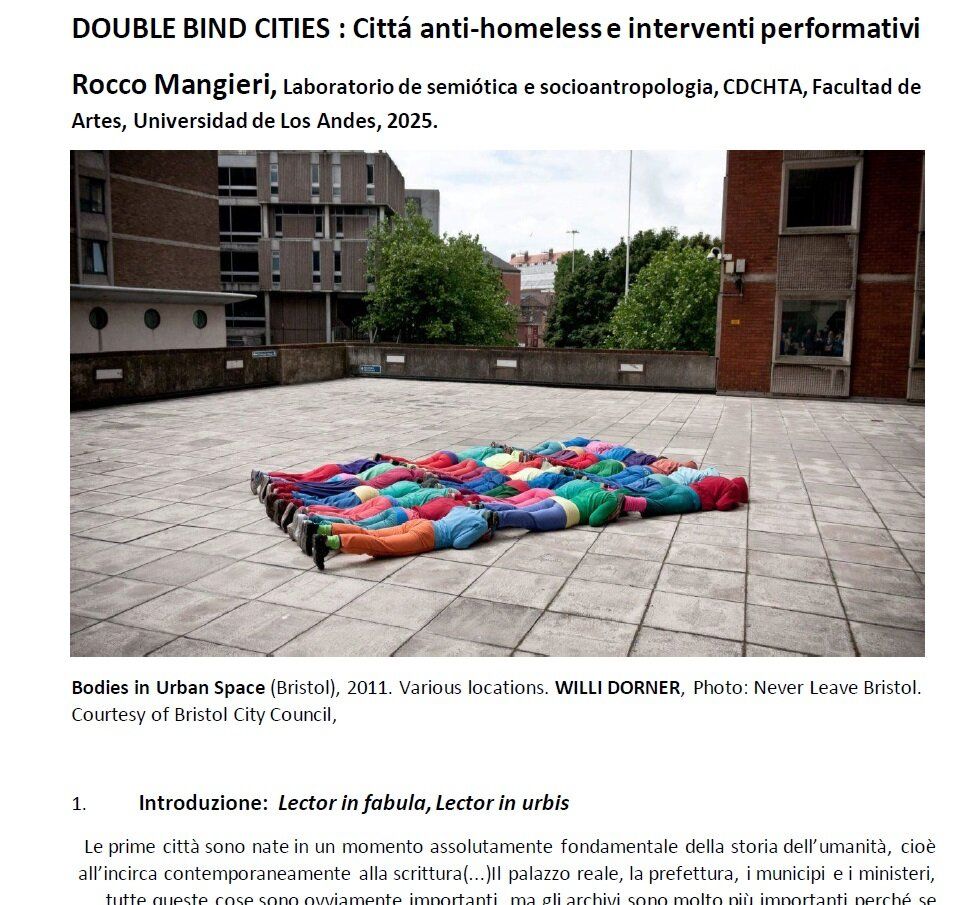
“Double Bind Cities” (2025) studies anti-homeless urban design — benches and other street furniture of so-called hostile design — as double-bind objects in Gregory Bateson’s sense: instructions for use that are paradoxical, and whose function is a prohibition. The unsheltered person does not obey them like the model reader the text anticipates. They adjust their body to the gaps in the form and answer with an art of paradox, closer to play and carnival than to an open attack.
The argument closes with a warning: an anti-homeless bench in a park in Milan, New York, Rome or Barcelona is only the tip of the iceberg. The city-text is increasingly saturated with instructions meant to control “good civic behaviour”, and semiotics, together with the other social sciences, has a responsibility to analyse them.